
QUALITY, SAFETY & SITE CONTROL
Zero-compromise high-altitude safety governance, millimeter-level dimensional surveying, dust-free silicone curing, and certified AAMA water-penetration resistance.
 Active Field Governance
Disciplined Site Presence
Every activity at height—from spider winch anchoring and cradle rigging to structural unit hoisting and sealant tooling—strictly follows verified Method Statements (MS) and safe Work Method Procedures (SWMS).
Project-Specific Quality Mandate
Prior to mobilizing on site, ANEXA submits custom Inspection & Test Plans (ITP), lifting engineering studies, chemical anchor pull-out test regimes, and statutory safety checklists configured to match client and PMC site rules.
Statutory Testing Codes Followed
Quality Planning & Engineering Submittals
Every facade project begins with detailed engineering submittals. We use client-approved 2D fabrication shop drawings, 3D BIM connection sections, structural static calculations, and full-scale physical visual mock-ups (VMU) to freeze all visual reveals, bracket anchors, and corner transitions before mass extrusion.
Dimensional Survey & Grid Control
Civil structures always exhibit out-of-plumb deviations and slab edge drops. Our optical total-station surveyors establish primary benchmark grids on every floor slab, documenting actual as-built conditions to allow custom bracket adjustments and eliminate forced on-site profile fitting.
Material Intake & Batch Traceability
Raw material integrity is controlled before items enter the workshop. Extrusions are checked for alloy 6063-T6 composition, PVDF coating thickness (microns), and glass batches are audited for roller wave distortions, bow-and-warp, and Heat Soak Test (HST) certification.
Precision Installation Quality
Daily site inspections monitor mullion alignment, expansion joint gaps, SS-304/316 fastener tightening torques, setting block positioning, EPDM gasket continuity, and clean weather silicone tooling to ensure weatherproofing and acoustic integrity.
HSE & Height Safety Coordination
High-altitude facade rigging is inherently critical. All cradles, scaffolding access, spider lifting cranes, and personal protective equipment (PPE) undergo daily toolbox inspections. Working crews operate on dual-rope safety lines with certified fall-arresters.
Systematic Closeout & Defect-Free Handover
Prior to dismantling external scaffolding, we conduct formal joint punch-list walkthroughs with PMC representatives. On-site field water spray hose tests (AAMA 501.2) are executed, and as-built drawings along with warranty dossiers are finalized for handover.
On-Site AAMA 501.2 Calibrated Water Spray Testing
Most facade leaks occur around mullion splices, perimeter flashing transitions, and screw penetrations. ANEXA conducts calibrated Monarch Type B-25 water nozzle spray testing at 30–35 PSI pressure directly against installed joints before interior gypsum ceilings are put in place.
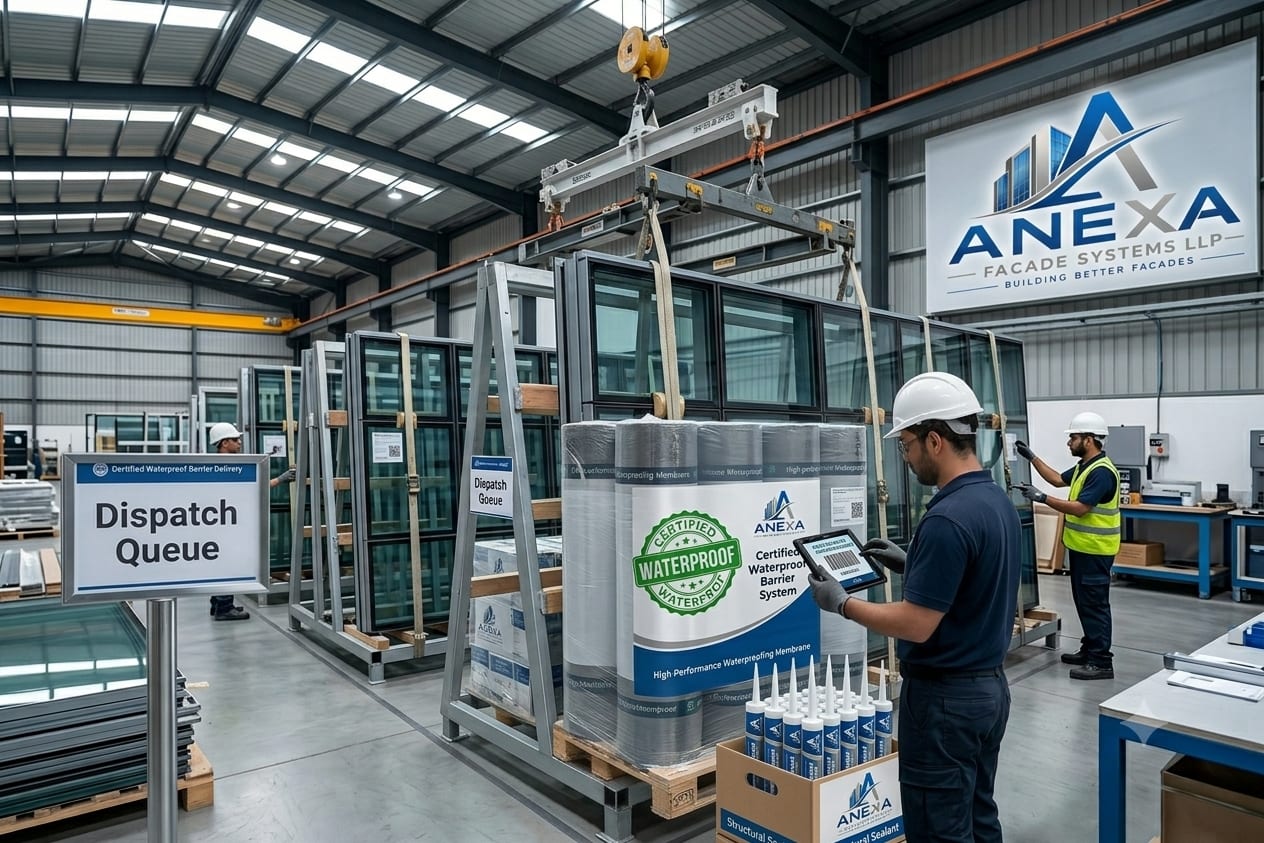
Certified Waterproof Barrier Delivery
Health, Safety & Environment (HSE) Discipline
We maintain a culture of personal accountability and strict procedural compliance across all high-altitude work fronts.
Fall Arrest Rigging
Mandatory 100% tie-off using dual-lanyard full-body safety harnesses, shock absorbers, and independent static lifelines.
PPE Compliance
EN-certified chin-strap hard helmets, high-visibility vests, cut-resistant glass handling gloves, and steel-toe safety boots.
Lifting Gear Audits
Third-party tested web slings, D-shackles, glass suction cups (dual vacuum circuits), and motorized hoisting cradles.
Barricading & Debris Catch
Ground-level perimeter catch nets, toe-boards on scaffolding, and marked exclusion zones beneath active rigging vertical drops.
Need Detailed ITPs or Method Statements for Tender?
Our site quality managers and static engineers can furnish standard Project Quality Plans (PQP), safety risk matrices, and testing schedules tailored for your project.